French Drain Installation & Yard Drainage in Chatham
A French drain is the most reliable way to fix a soggy lawn, standing water, backyard flooding, or a chronically wet basement in Chatham. It is a gravel-filled trench with a perforated pipe that collects excess groundwater and carries it safely away from your home and yard. Because our region sits on heavy clay soil that drains slowly, properly engineered drainage matters here more than almost anywhere in Ontario. Chatham Lawn Care designs, trenches, and installs long-lasting French drains for homes across Chatham.
What is a French drain and how does it work?
A French drain is a gently sloped trench filled with washed gravel and a perforated (slotted) pipe, wrapped in a filter fabric that keeps soil and silt out. Water in the surrounding soil takes the path of least resistance — it seeps into the loose gravel, drops into the perforated pipe, and flows downhill by gravity to a safe outlet such as a lower spot in the yard, a dry well, a rain garden, or a storm outlet. There are no moving parts, which is exactly why a well-built French drain can quietly protect a property for decades.
The name has nothing to do with France — it comes from Henry French, a 19th-century Massachusetts judge who popularized the design. The engineering behind it is simple but unforgiving: the trench must fall about 1% (roughly 1 inch of drop per 8 feet), the stone must be clean and washed so it doesn’t pack with fines, and the outlet must sit lower than the water you’re trying to remove. Get those three things right and the drain works flawlessly. Get any one of them wrong and the water just sits there.
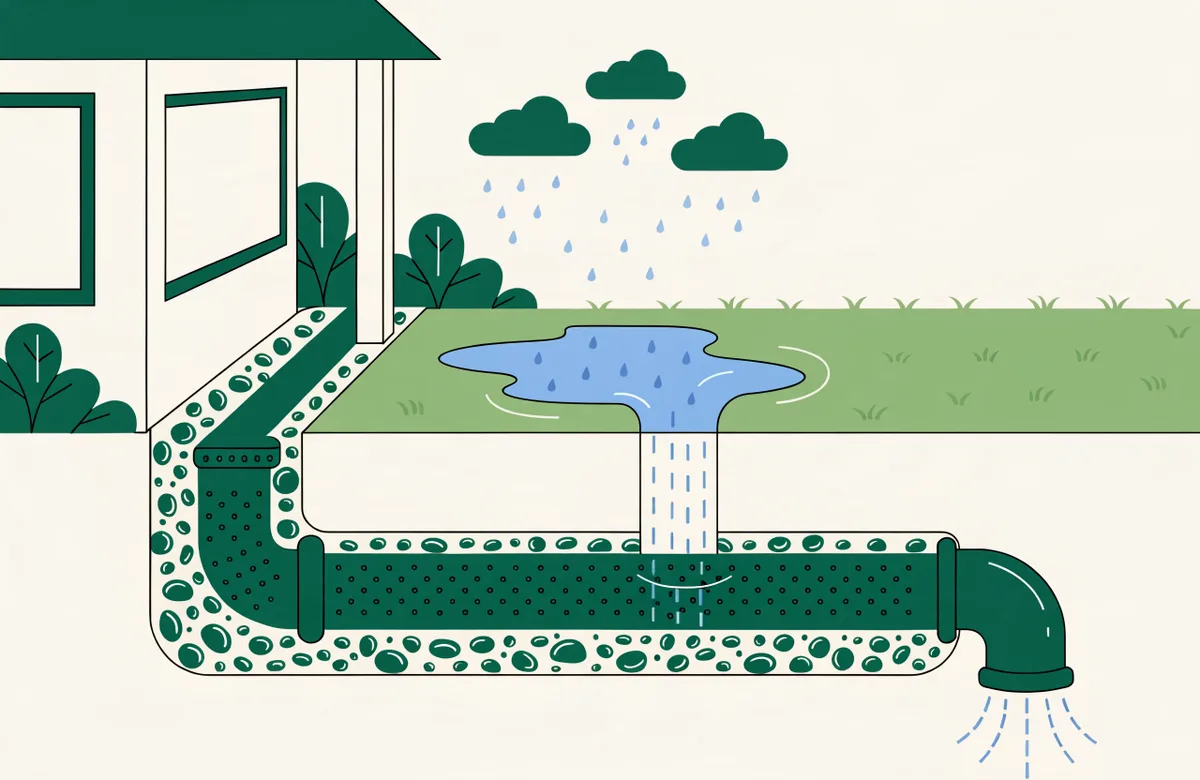
The anatomy of a drain that lasts
- Sloped trench. Excavated 12–24 in deep with a consistent ~1% fall toward the outlet.
- Filter fabric (geotextile). Lines the trench so clay and silt can't migrate in and clog the stone.
- Washed clear stone. 3/4" clean gravel — no fines — creates the voids water travels through.
- Perforated pipe. Slotted 4" pipe (holes down) sits in the stone and carries water fast.
- Bedding + backfill. Stone below and above the pipe, fabric folded over, then topsoil restored.
- A legal outlet. Daylight to grade, a dry well, or an approved connection — always lower than the source.
How we build a French drain: the “burrito wrap”
The difference between a French drain that lasts 30 years and one that clogs in two comes down to one detail: wrapping the stone and pipe completely in filter fabric — like a burrito.That full wrap keeps Chatham’s fine clay and silt out of the stone, so water keeps moving freely. Here’s exactly how we build every one:
- 1Native soil (heavy clay). Chatham clay holds water and drains slowly — exactly why a subsurface drain is needed.
- 2Filter fabric — wrapped like a burrito. Non-woven geotextile lines the trench and folds completely over the top, so silt and clay can never migrate in and clog the stone. This full wrap is what makes the drain last for decades.
- 33/4" clean washed stone. Washed clear stone with no fines creates the open voids water travels through to reach the pipe.
- 4Perforated pipe (holes down). A slotted 4" pipe sits low in the stone with the holes facing down, so water enters fast and is carried away.
- 5Sloped ~1% to a legal outlet. The whole run falls about 1 inch every 8 feet to daylight, a dry well, or an approved outlet — always lower than the water source.
Signs you need a French drain
Drainage problems rarely fix themselves — and on clay soil they tend to get worse, because water that can’t soak away keeps sitting on the surface. If you recognize any of these signs around your Chatham property, it’s time for a drainage assessment:
Standing water & puddles
Water that lingers on the lawn for more than 24–48 hours after rain, or spots that never fully dry out, mean the soil can't drain and water needs somewhere to go.
Soggy, spongy lawn
Ground that squishes underfoot, sinks when you mow, or grows moss and coarse weeds is chronically saturated — a classic clay-soil drainage symptom.
Wet or damp basement
Water seeping into the basement, efflorescence on the walls, a musty smell, or a sump pump that runs constantly all point to groundwater pooling against the foundation.
Mosquitoes & standing-water pests
Persistent puddles are a mosquito nursery. Removing standing water within a day or two of rain cuts breeding habitat off at the source.
Erosion, ruts & washouts
Channels cut into the lawn, exposed roots, mulch washing out of beds, and silt fanning across walkways show water is running uncontrolled across your property.
Foundation & hardscape damage
Pooling water near the house, settling patios, heaving walkways, and cracks that appear after wet seasons are warnings that water is undermining structures.
Not sure which of these apply to your yard? Request a free on-site assessment and we’ll trace where the water is coming from and where it needs to go.
Our French drain installation process
Every property drains differently, so we start by understanding the water before we ever break ground. Here’s exactly how a Chatham Lawn Care drainage project runs, start to finish:
1. On-site assessment & grading survey
We walk the property, identify the low points and the water source, shoot grades to confirm fall, check downspouts and existing drainage, and note utilities. You get a clear plan: where the drain runs, where it outlets, and a firm written quote.
2. Utility locates (Ontario One Call)
Before any digging, we file a locate request so gas, hydro, water, and telecom lines are marked. It's the law, it's free, and it keeps your dig safe. This is a step DIY installs and cut-rate crews routinely skip.
3. Trenching to the correct depth & slope
We excavate the trench 12–24 inches deep, maintaining a steady ~1% pitch toward the outlet the whole way. On clay, consistent slope is everything — we grade the trench bottom, not just the top.
4. Fabric, washed stone, perforated pipe
We line the trench with geotextile filter fabric, bed it with clean 3/4" washed stone, lay slotted 4" pipe (perforations down), surround it in more washed stone, then wrap the fabric over the top — a full 'burrito' that keeps silt out for the life of the drain.
5. Outlet & connections
The pipe daylights to a lower grade, a dry well, a rain garden, or an approved outlet. We can also tie in downspouts and yard catch basins so surface water and roof water are handled by the same system.
6. Backfill, restoration & clean-up
We backfill, restore topsoil, and re-seed or re-sod the trench line so the lawn recovers quickly. We test flow with water, walk you through the finished system, and haul away all debris. You're left with a dry yard, not a mess.
French drains vs. other drainage solutions
A French drain isn’t always the whole answer — the best fix depends on where your water comes from and where it can go. Often the right solution combines two of these. Here’s how the common options compare for Chatham properties:
| Solution | Best for | Limitations |
|---|---|---|
| French drain | Subsurface groundwater, soggy lawns, wet foundations, water with somewhere lower to go. | Needs a viable downhill outlet; more excavation than surface fixes. |
| Surface / channel drain | Fast runoff on paved areas, driveways, patios, and low spots that collect sheet water. | Only catches water at the surface — doesn't lower a high water table in the soil. |
| Dry well | Flat lots with no lower outlet; storing and slowly releasing collected water underground. | Works poorly in saturated clay that won't accept water; sizing is critical. |
| Regrading / swales | Redirecting surface water away from the house by reshaping the land's slope. | Limited where space is tight or grade can't be changed; won't fix deep groundwater. |
| Sump pump system | Low points and basements where gravity can't move water — pumps it up and out. | Mechanical: needs power and maintenance; usually pairs with a drain feeding the pit. |
We assess all of these during your quote and recommend the simplest combination that will actually keep your property dry — never the most expensive one. Proper surface grading is also the foundation of a durable gravel driveway; if your driveway ponds or washes out, see our gravel driveway rejuvenation & regrading service, which uses the same drainage-first thinking.
Why Chatham’s clay soil makes drainage critical
Chatham sits in the heart of southwestern Ontario’s clay plain — the flat, fertile lakebed left behind by glacial Lake Warren. It’s wonderful farmland, but it’s tough on drainage. Heavy clay soils have tiny, tightly packed particles, so water infiltrates extremely slowly — often less than a fraction of an inch per hour. Rain and snowmelt that would vanish into sandy ground instead pools on the surface and lingers for days.
Add the region’s naturally flat grade (which is why the whole area depends on an extensive network of municipal and agricultural drains) and a high seasonal water table, and you have the perfect recipe for soggy lawns, wet basements, and backyard flooding. This is exactly why so much of Chatham farmland is tile-drained — and why residential properties here benefit from the same principle: give the water an engineered path out.
It also means clay demands the drain be built right. Clay will happily migrate into and clog a poorly built drain, so the filter fabric and washed (fines-free) stone aren’t optional extras here — they’re the difference between a drain that lasts decades and one that silts up in a couple of seasons.
What clay soil means for your project
- Water sits longer, so small drainage problems escalate faster.
- Filter fabric + washed clear stone are essential, not upgrades.
- Correct, consistent slope matters more — there's no forgiving sandy sub-base.
- Outlets need planning on flat lots; a dry well or sump may be required.
- Getting it engineered right the first time saves re-digging a failed DIY trench.
What affects French drain cost in Chatham?
Most residential French drain projects in Chatham land between roughly $2,000 and $8,000, with a typical backyard job around $3,000–$5,000. Rather than a one-size number, here’s what actually moves the price so you can see where your project fits:
Length of the drain run
Longer runs mean more trenching, stone, pipe, and labour — the single biggest cost driver.
Trench depth
Foundation-depth drains are far more involved than a shallow lawn drain and cost more per foot.
Distance to a viable outlet
If water has to travel far to reach a lower outlet — or needs a dry well or sump — costs rise.
Soil & access
Heavy clay, rock, tree roots, and tight backyard access all add excavation time.
Downspout & catch-basin tie-ins
Connecting roof and surface water into the system adds components but often saves a second project.
Restoration scope
Re-sodding a manicured lawn or restoring hardscape costs more than seeding an open yard.
The honest answer is that pricing is property-specific — a free on-site quote is the only way to get an accurate figure. Ask about our seasonal fall service offer when you book, since fall is an ideal, settled time to install drainage before the next thaw.
French drain FAQ — Chatham
Straight answers to the questions we hear most about yard drainage and French drains in Chatham and across Chatham.
How much does a French drain cost in Chatham?
Most residential French drain projects in Chatham run between roughly $2,000 and $8,000, with a typical backyard drainage job landing around $3,000 to $5,000. Price depends on trench length, depth, how far the water has to travel to a good outlet, and how much of the run passes through heavy clay. Because every yard drains differently, the only accurate number is a free on-site quote, which we provide within 24 hours.
How long does a French drain last?
A properly installed French drain — dug to the right depth, wrapped in filter fabric, and backfilled with clean washed gravel — typically lasts 30 to 40 years or more. The most common reason a drain fails early is silt clogging the pipe, which happens when the gravel or fabric is skipped or the wrong materials are used. We build every drain with a perforated pipe, washed stone, and a full fabric sock so it keeps flowing for decades.
Will a French drain fix my wet basement?
Often, yes. An exterior French drain installed along the foundation intercepts groundwater and surface runoff before it reaches your basement wall, and pairing it with proper grading and downspout extensions solves most chronic basement seepage. If water is already entering through cracks or below the footing, an interior weeping-tile system or foundation repair may be needed too. We assess the source on-site and recommend the right combination — we never sell drainage you don't need.
Do I need a permit to install a French drain in Chatham?
A standard yard or foundation French drain that stays on your own property and daylights to a surface outlet usually does not require a building permit in Chatham. Permits or approvals can be needed if you connect to the municipal storm system, discharge across a property line, or work near a drain, ditch, or watercourse regulated under the Drainage Act or the local conservation authority. We handle locate requests (Ontario One Call) on every dig and advise you if any approval applies to your specific property.
What is the best time of year to install a French drain in Ontario?
Late spring through fall is ideal because the ground is workable and not frozen, but a French drain can be installed any time the soil isn't frozen solid or waterlogged. Spring is popular because that is when homeowners notice standing water and soggy lawns after snowmelt. Fall is excellent too — the yard has time to settle and re-establish before winter, and you head into the next thaw already protected.
French drain vs. sump pump — which do I need?
They solve different problems and often work together. A French drain is a gravity system that collects and carries water away, while a sump pump actively lifts water out of a pit when gravity alone can't move it — common on flat lots or below-grade basements. If your yard can drain downhill to a lower outlet, a French drain alone may be enough; if the low point is your basement, a French drain feeding a sump pit is the reliable combination.
Can I install a French drain myself, or should I hire a pro?
A short, shallow drain in sandy soil is a doable DIY project, but Chatham's heavy clay makes most drains harder than they look — you need the correct slope (about 1% fall), the right washed stone and filter fabric, a legal outlet, and careful trenching around utilities. Getting the pitch or the outlet wrong means the drain simply doesn't work and the trench has to be re-dug. Hiring a pro gets it engineered right the first time, with utility locates, proper materials, and full lawn restoration.
Does a French drain help with mosquitoes and standing water?
Yes. Standing water on a lawn is a prime mosquito breeding ground, and a French drain removes the standing water that mosquitoes need to lay eggs. By draining low spots within 24 to 48 hours of rain instead of letting them sit for days, a properly graded drain dramatically cuts mosquito habitat while also stopping the lawn damage, mud, and odour that come with chronic wet spots.
Stop fighting a wet yard — let’s drain it properly
Get a free, no-obligation drainage assessment for your Chatham property. We’ll find the source of the water, design the right fix, and give you a clear written quote within 24 hours.
Serving Chatham and the surrounding Chatham communities.